Multitasking Is a Myth. Here's What to Do Instead.
Notes from my Monday Mindset session with TechPixies
I''d just finished Johann Hari's Stolen Focus. It's a meaty read, but the first section stopped me in my tracks and it is what I chose to share.
It explained something I see in almost every client I work with: we are not built to multitask, and trying to anyway, is quietly costing us far more than we realise.
Firstly, We don't multitask. We switch.
Here's the myth I want to debunk: multitasking doesn't exist. Our brains don't run two things at once, they switch between them, lightning fast. What feels like doing three things together is actually your brain doing one thing, badly, three times over.
And there's a cost to that switching. The research Hari cites is stark:
-
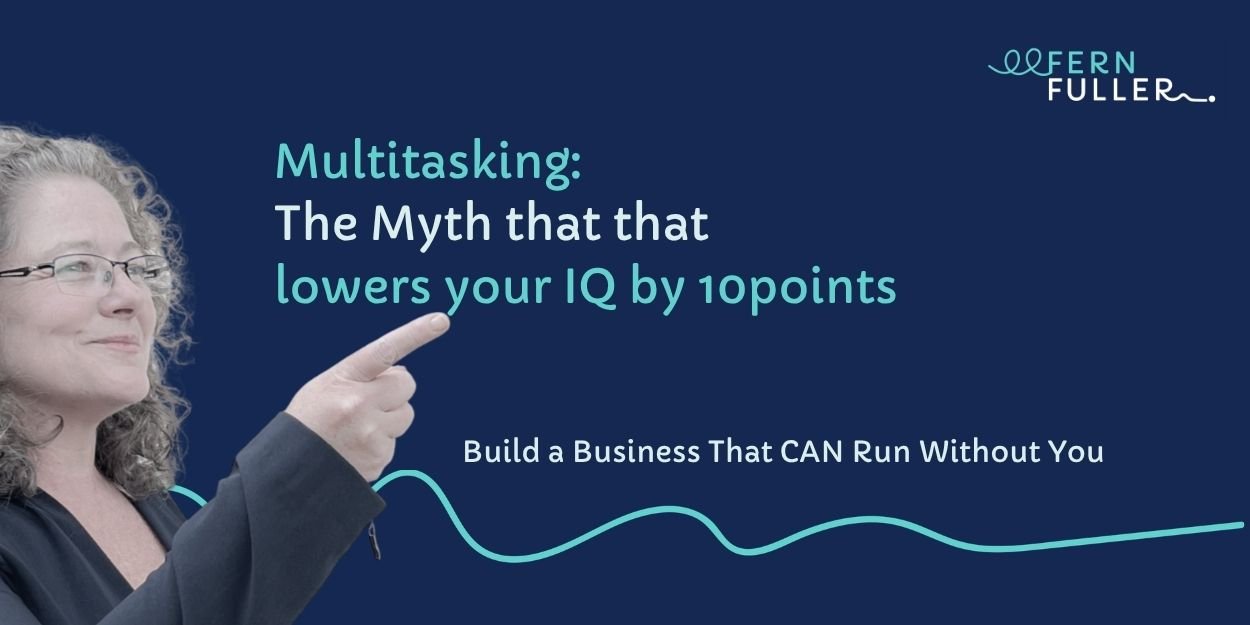
Your effective IQ drops by around 10 points every time you switch tasks, a similar hit to smoking cannabis.
-
You make more errors. Hari calls it the "screw-up effect" : your brain has to rewind to find where it left off, and in doing that rewind, it skips or misses things. So you spend time correcting mistakes you wouldn't have made if you'd just stayed on one thing.
-
You lose creativity. New ideas come from your brain quietly connecting things you've seen, heard and learned, but only when it has the free, undistracted space to do that. Keep it switching and it never gets the chance.
-
You remember less. Ever eaten standing up in the kitchen and felt hungry again ten minutes later? Same principle. If you weren't really there for it, your brain doesn't file it as done, so it keeps nagging at you.
And it's not just about switching apps or tasks. It's information itself. Between phones, TV, emails, other people's opinions and the news, we're not choosing to when to access information. Our brains were never built to cope with that volume. It's not a personal failing. It's the environment.
You can't fix what you haven't faced
Before any of this changes, you have to actually see the problem. Hari uses a lovely image for it: imagine your windscreen is covered in mud, and instead of cleaning it, you're panicking. The fix isn't a new car. It's wiping the windscreen.
There's a line in the book, credited to James Baldwin, that sums it up:
"Not everything that is faced can be changed, but nothing can be changed until it is faced."
That's step one. Notice what you're noticing. You don't need to fix it today , you just need to stop pretending it isn't there.
Flow states is not just about being productive.
Research shows that flow states make us happier by reducing self-focus, triggering reward chemicals, and lowering depression risk.
Mihaly Csikszentmihalyi contributed pioneering work to our understanding of happiness, creativity, human fulfillment and the notion of "flow" a state of heightened focus and immersion in activities such as art, play and work.
The Zeigarnik Effect: First observed by psychologist Bluma Zeigarnik in the 1920s, research shows that the human brain keeps uncompleted or interrupted tasks active in the prefrontal cortex, creating persistent background tension and intrusive thoughts.
Flow states help close loops. Closing a loop, even a tiny one, gives you a hit of completion. Your brain likes that. It actually physically rewards you for finishing things. Which means, you want to do more.
Getting into flow: the four conditions
Once you've acknowledged the problem, the goal is getting back into flow .
Willpower won't get you there on its own , it's mostly gone by 10am, once you've got up, fed everyone, and made a dozen small decisions before your day has even started. Your why is what carries you when it gets hard. Willpower and motivation are limited. Purpose isn't.
- Choose one goal. Decide what you're doing, and set everything else aside while you do it. Flow cannot happen alongside multitasking — it needs monotasking.
- Make it meaningful. Your brain pays attention to what matters to you. If you don't know your why, dig for it (the "five whys" technique works well here)
- Push slightly outside your comfort zone. Not so easy you're on autopilot, not so hard that anxiety kicks in and sends you looking for a distraction (hello, sudden urge to make coffee).
- Set aside your other goals while you do it. No half-attention. One thing, properly.
Using Your Calendar To Get To A Flow State
This is the part I actually use, every day, with every client. Once you've accepted you need focused time, here's how you protect it.
Your calendar isn't just a reminder system. It can function as your executive function specificity plus true white space, so you can see a wipe-out day coming and move things before you're in crisis, not after.
The toolkit: my four B's + one D
Batching & blocking Just blocking ot time or batching you day is not enough! I recommend getting specific: Block finance time, add the detail e.g reconciling on the first Friday, invoicing on the second. It's the difference between "go grocery shopping" and an actual list , without the list, you wander around and come home with a cucumber and no toilet roll.
Then layer the detail: use the notes field to drop in every link you'll need (the spreadsheet, the client file, the map, the tickets) so you're never tempted into a "quick look" at your inbox or start a digital library hunt.
Bundling — grouping similar tasks together so your brain isn't constantly re-loading a different kind of thinking. Team meetings and admin at the start of the week; deep, undisturbed writing or project time in the back half. You've cleared the cognitive load early, so nobody's waiting on you and your brain is free to properly settle into the harder work.
Boxing giving something a hard time limit. Two hours for LinkedIn posts, then I stop, whatever state it's in. It stops one task swallowing your whole day, and it quietens the "but what about—" voice in your head, because you already know when you'll get to the rest.
Day theming . This is my go to for my AuDHD clients. Days of intensity and days of nothing to recharge. Deciding, at the top level, what kind of day each day is.
What came up in the room
A few moments from the discussion that I want to hold onto:
On ADHD and time blindness — one attendee, recently and late-diagnosed, described masking for 30 years in a high-performing job, multitasking successfully right up until burnout. She'd found that standard time-blocking fought her brain rather than working with it, and that she needed to "go the long way round". Her go to was, starting in Canva before she could write , to get anywhere at all.
The advice that landed: stop punishing yourself for the shape your focus takes. If Canva is where your brain gets creative, go straight there put the link to the actual document in your calendar entry, not just a vague label, so you're never even tempted to go looking for it but add a time box to it.
On not being a morning person — someone asked how to get rid of the assumption that everyone's sharpest at 9am. The answer: you don't get rid of the assumption, you get rid of the guilt.
For 5 years I have not put anything in my diary before 10am, because I got tired of being late and feeling guilty about not being present for work or parenting. That's simply data, not a flaw.
One of my clients does her best thinking from 4pm, so evenings are her protected creative time, and dinner gets planned around that, not the other way round.
Once you know your pattern, the job isn't to fight it. It's to build the day around it and stop apologising for it.
"Success isn't about the hour you wake up. It's about the quality, intensity, and consistency of the hours that follow." — Richard Branson
Monotasking is the way to be more productive. Not busier. Not "doing more." One thing, properly, at a time.
The fix isn't willpower. It's structure: knowing your pattern, protecting the time, and being specific enough that your calendar can do the remembering for you.
And it's not just about the big blocks. Even a small open task left hanging — an email half-drafted, a decision not yet made, sits in the background using up energy you don't know you're spending.
NOTE: You don't always have to finish it to get the relief. Writing down the concrete next step ("I will do this Thursday at 2pm") signals closure to your brain almost as effectively as finishing the thing itself. Close the loop, even if the task isn't done yet.
Underneath all of it is a theme I keep coming back to with every client, every session: notice what you notice. You are not your thoughts, you are the thinker of them.
The moment you can see the pattern (the mud on the windscreen, the task you keep moving, the hour you keep pretending doesn't work for you) is the moment you can actually do something about it. Not fix it overnight. Just see it. That's always where it starts.
Simple. Not easy. But worth it.
If any of this landed and you want to go further:
-
Grab my free calendar course → 9 minutes in totoal. Short, practical walk-through of exactly the batching, boxing, bundling and day-theming approach covered here, so you can set your own calendar up to do the remembering for you.
-
Book a business clarity call → if you already know your overloaded and multitasking is the least of your worries book a paid call. We can figure out what isn't working for you and what to change.
__________________________________
I didn’t arrive in the world of founder transformation by accident. It wasn’t a career pivot; It was leaning into what I do best.
💬 If you want the next quarter to be different, let’s talk. You don’t have to carry this alone. Lets chat: Book a free Discory call here: https://fernfullerservices.com/contact/